
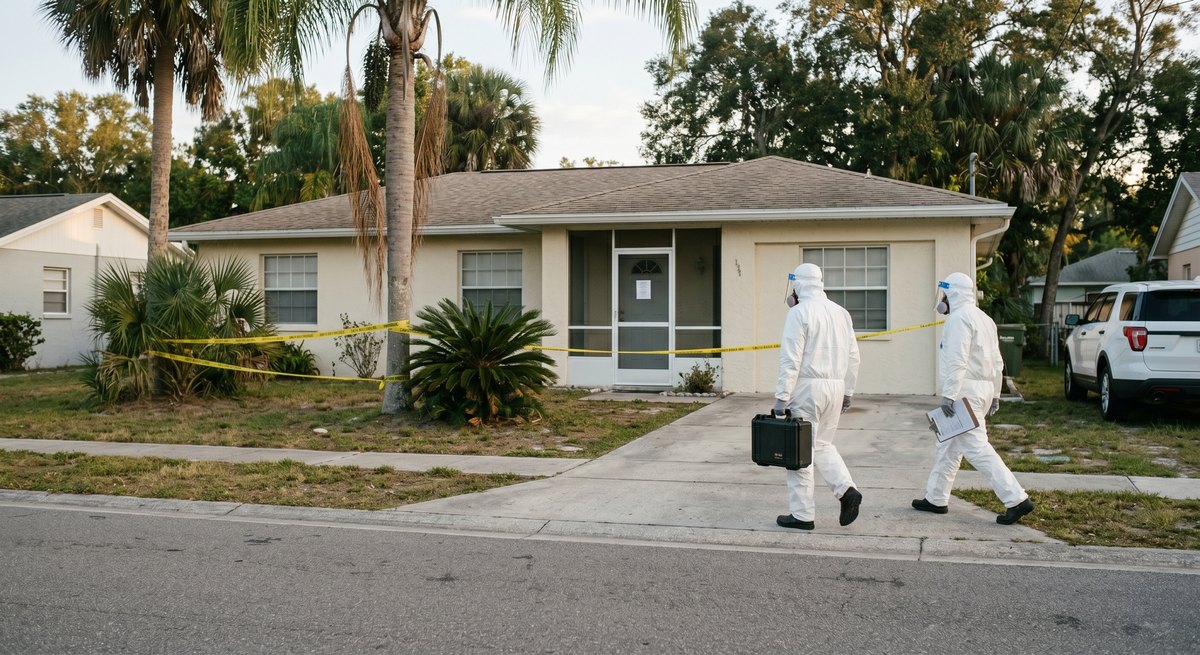
In the last few weeks I've had six customers ask me the same thing. "Ron, you saw the news about the cruise ship? That hantavirus thing. The rats in my attic, can I get that?" Fair question. I figured I'd write up the real answer once instead of telling it six more times.
TL;DR
- The hantavirus on that cruise ship is a South American strain called Andes virus. The rodent that carries it does not live in the United States.
- Florida has its own hantavirus carried by the native cotton rat, but only three confirmed cases have been reported in the state across thirty years.
- Your odds of contracting it here are very low. Your odds of dealing with regular rodent problems are not.
- The single most important thing you can do: never sweep or vacuum dry rodent droppings. Ventilate, spray with bleach solution, let it sit, wipe up with paper towels, double-bag.
- Seal entry points the size of a dime or larger. Cut back brush from the house. Lock down food sources. Call us if it's bigger than you want to handle.
What hantavirus is, in plain terms
Hantavirus isn't one virus. It's a family of them. More than fifty types have been identified worldwide, and each one is carried by a specific kind of rodent.1 The rodent doesn't get sick from it. Lives its whole life carrying the thing around, shedding it in urine, droppings, and saliva. Humans get exposed almost always one way: we breathe in dust from a space where infected rodents have been living. Sweeping out a shed. Opening up a deer camp cabin that's been closed for the winter. Cleaning droppings out of an attic with a Shop-Vac. That's the move that gets people sick.
In the Americas the disease form is called Hantavirus Pulmonary Syndrome, HPS for short. Hits the lungs hard. In Europe and Asia it's a different syndrome that hits the kidneys.2 The lung version is the one we worry about over here. And yes, it can kill you. CDC pegs the fatality rate around 38 percent once respiratory symptoms hit.3
That number gets people's attention, as it should. But you have to look at it next to how rare the disease actually is. The whole country, all fifty states combined, averages somewhere between fifteen and forty confirmed cases a year.4 Total. For comparison, more people get hit by lightning. Read that twice if you have to.
So what happened on that cruise?
A Dutch ship called the MV Hondius left southern Argentina on April 1st. About a hundred and forty-nine people on board. A few weeks in, passengers started getting sick. Fever, body aches, then pneumonia, then full respiratory failure. Three deaths so far.5
The strain they identified is called Andes virus. It's a hantavirus, yes, but a specific one that lives in southern South America. The rodent that carries it is the long-tailed pygmy rice rat. Skinny little thing that lives in temperate forests and grasslands down in Patagonia and Chile.6 Here's the thing nobody on the morning news bothers to mention. That rodent does not exist in the United States. Not in Florida. Not in any state. Period.7
The reason Andes virus made the news in the way it did is because it's genuinely unusual in one respect. Out of every hantavirus on Earth, Andes is the only one ever documented to spread directly from one person to another.8 Every other hantavirus, including all the ones in the U.S., only spreads rodent to human. Full stop. Even Andes is bad at person-to-person spread. A virologist at UC Riverside put numbers on it: COVID at its peak, one person infected fifteen to twenty others on average. Andes virus, an infected person infects fewer than one.9
What turned a small Argentine virus into an international story is that the ship was a closed box. Same people, same air handling, sharing meals, for weeks. That's the only environment where the math works against you. WHO came out and said the global risk is low. CDC put it at a Level 3 response, which is their lowest classification.10 So when somebody asks me if this is the next pandemic the honest answer is no, and the people who study this stuff for a living agree.
The cruise ship outbreak is a South American story. Florida's rodent risk is a different conversation.
Okay Ron. But what about here?
This is the part you actually came here for, so I'll give it to you straight.
The cruise virus, Andes, is not a Florida problem. The rodent isn't here, the virus isn't here, and the few Americans who were on that ship are being monitored back home with no symptoms so far.11
Florida does have its own hantavirus story though, and most folks don't know about it. Back in 1995 researchers in south Florida pulled a hantavirus out of a sick patient and traced it back to the hispid cotton rat. They named it Black Creek Canal virus after where they found it.12 The hispid cotton rat is a native Florida critter. Lives in brushy fields, palmetto thickets, the edges of citrus groves, drainage swales, that kind of thing. They tested rats around that one patient's home and found about thirteen percent of them carrying antibodies. So yes, the virus is technically out there in our native rodent population.
Now here's the perspective part. CDC data shows Florida has had three confirmed hantavirus cases between 1993 and 2023. Three. In thirty years.13 Your odds of running into it are extremely low. I've crawled through I don't know how many hundreds of attics in this county and I've never had a customer come down with it. Not once.
That said, the cotton rat is real, and it does turn up around houses that back up to wooded lots, retention ponds, or overgrown property lines. The roof rats and house mice we deal with inside Florida homes most of the time aren't the primary local hantavirus reservoir, but the prevention rules are the same either way, so just play it safe. Treat any rodent waste like it could make you sick, because plenty of other things in there can. Salmonella. Leptospirosis. Roundworm. Allergens that'll wreck your sinuses for a month. Hantavirus isn't the only thing that comes out of a dirty attic. It's just the one in the headlines this week.
The one thing I see people do wrong every single time
If you remember nothing else from this whole article, remember this part.
Do not sweep or vacuum dry rodent droppings. I cannot tell you how many times I've walked into a garage or shed and seen a homeowner standing there with a push broom or a Shop-Vac. It's the single worst thing you can do. You're literally throwing virus particles into the air you're about to breathe in. Sweeping and vacuuming is how this disease gets into people. Every public health agency I've ever read says the same thing.14
The right way takes ten more minutes and it's worth every one of them:
- Air it out. Open the windows, open the doors, walk away for thirty minutes. Let the space ventilate before you go in to clean.
- Glove up. Rubber or heavy plastic gloves. If the contamination is heavy, put on an N95 too. I always do.
- Spray, don't sweep. Mix one part bleach to ten parts water, or grab any household disinfectant. Soak the droppings, the urine spots, the nesting material. Let it sit at least five minutes. The bleach kills the virus on contact.15
- Wipe up with paper towels. Double-bag everything when you're done. Paper towels, gloves, the works. Tie it off and into the trash.
- Wash your hands like you mean it. Hot water, soap, full twenty seconds. Disinfect any tools you used.
That's it. That's the protocol public health uses, that's the protocol I use, that's what I tell every customer who calls me asking about cleanup. Works for hantavirus and works for the dozen other things you don't want in your lungs.
Keep them out in the first place
Best cleanup is the one you never have to do. After thirty years I can tell you the basics in plain English.
A house mouse can squeeze through a hole the size of a dime. About a quarter inch. That's it.16 So when you're looking around the outside of your house, you're not looking for big openings. You're looking for nickel-sized and smaller. Around AC line penetrations. Where the cable comes in. Soffit gaps. Garage door corners. The seam where your block wall meets the roofline. Pack those with steel wool or hardware cloth and seal them. Do not just spray foam in there. They'll chew right through foam in a weekend.
Cut back what's against the house. Florida's love affair with thick foundation landscaping is great for curb appeal and terrible for keeping rodents out. Palmetto pressed against the wall is a rodent hotel with a continental breakfast. Move woodpiles, compost bins, and lawn debris at least a few feet off the structure.
Lock down the food. Pet food in sealed containers, not the original bag. Trash cans with tight-fitting lids. Pick up fallen citrus. If you have bird feeders and you're seeing rodents, you've got to pick one. Can't have both.
Snap traps along walls, not out in the middle of the floor. Rodents run the edges of a room. They almost never cross open ground if they can help it. Bait stations if you go that route, but be smart about it. Anticoagulant baits are just as dangerous to your dog as they are to the rat.
When it's worth calling somebody
If you're hearing scratching in the walls or ceiling at night, finding fresh droppings regularly, seeing chewed wires or torn-up insulation, or you've got an attic, shed, or outbuilding that's been a rodent home for who-knows-how-long, that's when you stop and call somebody. A space that's been heavily occupied is exactly the situation public health agencies tell homeowners not to DIY.17 Too much aerosol risk, too much chance you're going to miss entry points and have them back in six weeks.
That's what we do. We come out, find every hole, seal it properly, decontaminate the space the right way, and set up an exclusion plan so it doesn't happen again. No contracts, no monthly nonsense.
Got rodents? Let's take a look.
Free estimate. No obligation. Brevard County's local rodent guys.
Bottom line
Three people died on that cruise ship and that's a real tragedy. I'm not making light of it. But it's a southern South America problem that happened to get amplified inside a floating petri dish. It is not knocking on Florida's door. The rodent isn't here. The virus isn't here. And the broader hantavirus risk in our state, while not zero, is so rare that I've never personally had a customer affected by it in three decades of doing this work.
What I'd want you to walk away with is the boring version, because boring is what actually protects you. Don't sweep dry droppings. Seal the small holes. Cut back the brush. And if it gets bigger than you want to handle, you know where to find us.
Stay safe out there. Ron
Sources
- CDC, "About Hantavirus." cdc.gov/hantavirus/about
- World Health Organization, "Hantavirus cluster linked to cruise ship travel, Multi-country," Disease Outbreak News, May 4, 2026. who.int
- CDC, "Clinician Brief: Hantavirus Pulmonary Syndrome (HPS)." cdc.gov/hantavirus/hcp
- CDC, "Reported Cases of Hantavirus Disease." cdc.gov/hantavirus/data-research
- "MV Hondius hantavirus outbreak," Wikipedia (live updated). en.wikipedia.org
- European Centre for Disease Prevention and Control, "Hantavirus-associated cluster of illness on a cruise ship: ECDC assessment and recommendations," May 6, 2026. ecdc.europa.eu
- CDC, "About Andes Virus." cdc.gov/hantavirus/about/andesvirus
- Ferres et al., "Immunocytochemical and Ultrastructural Evidence Supporting That Andes Hantavirus (ANDV) Is Transmitted Person-to-Person Through the Respiratory and/or Salivary Pathways," Frontiers in Microbiology, 2019. frontiersin.org
- UC Riverside News, Q&A with Dr. Scott Pegan, "Hantavirus outbreak on cruise ship raises transmission concerns," May 7, 2026. news.ucr.edu
- WHO Disease Outbreak News, May 4, 2026. who.int
- TODAY.com, "Could the Hantavirus Cruise Ship Outbreak Lead to a Pandemic? Experts Explain the Risk Level." today.com
- Khan AS et al., "Hantavirus pulmonary syndrome in Florida: Association with the newly identified Black Creek Canal virus," American Journal of Medicine, 1996. sciencedirect.com
- Florida Department of Health, "Hantavirus Pulmonary Syndrome." floridahealth.gov
- National Emerging Special Pathogens Training and Education Center (NETEC), "Understanding Hantavirus Pulmonary Syndrome." netec.org
- CDC, "Hantavirus Prevention." cdc.gov/hantavirus/prevention
- Mayo Clinic, "Hantavirus pulmonary syndrome, Symptoms & causes." mayoclinic.org
- Harvard Health Publishing, "Hantavirus explained: What to know after the cruise ship outbreak." health.harvard.edu
Frequently Asked Questions
Is the hantavirus from the cruise ship outbreak a risk in Florida?
No. That outbreak was caused by Andes virus, carried by a rodent species that lives only in southern South America and does not exist anywhere in the United States.
Does Florida have its own hantavirus risk?
Yes, a different and much rarer one. Florida's native cotton rat can carry a local strain, but the state has confirmed only three hantavirus cases in the past thirty years.
What is the single biggest mistake people make cleaning up rodent droppings?
Sweeping or vacuuming them dry. That throws virus particles into the air you're about to breathe. Ventilate the space, soak the droppings in a bleach solution, then wipe up and double-bag them.
How small of a gap can a mouse get through?
About the size of a dime, roughly a quarter inch. Sealing needs to focus on small gaps around AC lines, cable entry points, soffits, and garage door corners, not just the obvious openings.
Dealing with this at your place?
Gator Pest Control has served Brevard County since 1994. Free estimates, no contracts.
Get a Free Estimate Call (321) 253-1188